

| MENU |



The cage in the left hand light contains the two doves brought as a sacrifice. In the right hand light
near the top, Mary and Joseph are seen peering from behind a column. These two events remind us of
our Baptism and Confirmation.
The "Artist's Mark" in the bottom right hand corner of the left hand window shows us that the
windows were designed and made byAlfred Robin Fisher at the Chapel Studio in Kings Langley, Herts
in 1978.
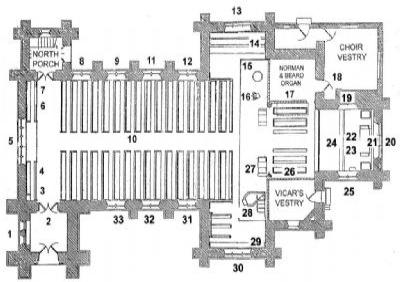
The INSCRIPTION (2) over the glass doors ("Let us enter into his gates with thanksgiving" etc) as you
enter the church is original. Similar inscriptions were painted over the windows inside the church but
were painted over when the church was decorated sometime after 1937.
The GLASS DOORS replaced the original timber doors and draught curtain in September 1989 and were
a gift from Lord Leverhulme to celebrate the centenary of his family's connection with Thornton Hough.
Inside the church, MOTHERS UNION BANNERS (3) have been in use since June 10th 1958 when the first
banner was dedicated in memory of Canon J Edwin Smith who was Vicar of All Saints 1953/54. It was
Canon Smith's wife who started the movement in Thornton Hough on 12th January 1954. The banner
on display was made by one of the branch members, Mrs Vicky Patrick Davies in memory of the late
Mrs Eveline Bernard and was dedicated in January 1994.
The BRASS TABLET (4) on the west wall is in memory of George Jellicoe who returned from the Boer
War where he had served in the 8th King's Liverpool Regiment and was at the relief of Ladysmith. He
served as Verger and Sexton for over fifty years and died in office in 1958, aged 84 years.
The WEST WINDOW (5) depicts"St Michael and all the Angels in victorious conflict over the Dragon",
and was placed there in the 1920s in memory of those men from the church who gave their lives
during the First World War. It was necessary to first remove the Gallery which ran along this wall and
was reached by a staircase from the North Porch. The doorway at the South end of the Gallery can still
be seen. The Gallery seated 100 and when used was mainly for children.
Beneath the window is the Roll of Honour showing the names of 30 men and boys from the church
who died for their country during the First World War. Fifteen of these names are also recorded on the
War Memorial in the centre of the village together with another two names.
The CROSS (6) temporarily marked the grave of an unknown British soldier on the Western Front
during the 1914-1918 war. It has been entrusted to the care of this church by the Imperial War
Graves Commission.
The STANDARD (7) of the Thornton Hough and District Branch of the Royal British Legion has been laid
up in All Saints Church since November 1962, when a new Branch Standard was dedicated. The
Standard was carried for nearly thirty years at many parades of ex-servicemen held at Thornton
Hough and other parts of Cheshire and Lancashire.
Beneath this standard is the PEW used by the Leverhulme family with coronets woven into the fabric
of the cushions.
The first WINDOW (8) on the north side of the nave is in memory of the Griffith family who farmed at
Raby village from 1688-1981. The scene depicts Mary and Joseph with baby Jesus surrounded by farm
animals and a shepherd. The window also shows the Griffith homestead.
The "Artist's Mark" near the bottom of the right hand light shows that the window was crafted by
Celtic Studios of Swansea in 1982.
WINDOW (9) Jesus talking to children in modem dress with the inscription "Let the children come to
me, do not try to stop them" Luke 18:16 and is in memory of Celia E. Ward who was Headmistress of
the village school from 1928 until 1959. The tracery at the top of the window contains references to
Miss Ward's interests of music and flowers, and a pen and book - symbols of her calling. The window
was designed by Alfred R Fisher of Chapel Studio, Kings Langley, Herts in 1977.
The TAPESTRY KNEELERS (10) were designed and worked by members of All Saints and depict local
scenes, organisations and religious items and were completed in 1991.
WINDOW (11) shows a sower sowing seed with the inscription "O all ye works of the Lord, Bless ye
the Lord, Praise him and Magnify him for ever". The window is in memory of William and Catherine
Fryer and was a gift from their daughter Kate Fryer.
The "Artist's mark" near the bottom of the right hand light shows us that the window was designed
and made by Whitefriars Glass Ltd. of Wealdstone, Middlesex in1953.
WINDOW (12) shows a Reader at this church's lectern and a Lady in Victorian dress with the
inscription "Thy word have I hid in my heart" and is in memory of James Angus Murray of Thornton
House who was a Reader at this church for many years. The window also shows Thornton House and
the artists mark in the right hand light shows that it is the work of the William Davies Studio from Irby,
Wirral in 1997.
The NORTH TRANSEPT WINDOW (13) is in memory of James Darcy Lever (1854-1910), who lived in
Thornton House and was the brother of the first Lord Leverhulme. The theme is "All Saints" and
depicts St. Michael the Archangel, in armour and sword overcoming the evil serpent, surrounded by
saints and angels. Note the symbols of sacrifice on either side: the Lamb standing with the banner
and the Pelican feeding her young from the bleeding breast. The window was a gift from James Darcy
Lever's widow and family and his niece Mary Ethel Dean in 1912 and was crafted by H Gustave Hiller of
Liverpool whose name is shown at the bottom of the right hand light.
The BRASS TABLET (14) is in memory of John Wesley Aldom M.A. the first Vicar of this parish 1867-1897
and was a gift of the parishioners of Thornton Hough in 1897.
THE FONT (15) is of Caen stone and was crafted by Mr T Ruddock of London. The words carved on the
rim "Suffer little children to come unto me" are from Mark 10:14. The font was originally located, as in
many other churches, at the back of the church near to the door, but in 1989 it was decided to move
the font to the front of the church so that baptisms could become part of a normal service.
THE LECTERN (16) is of oak and is original.
The Norman and Beard ORGAN (17) was built in 1912 and replaced the original organ built by Messrs
Gray and Davison of London. The materials of the old Organ were taken by the builders in part
payment and the remainder of the cost was paid for by voluntary contributions.
The CHOIR VESTRY (18) was also built in 1912 in memory of William Hodgson Potter and his wife
Elizabeth of Cloverley, Brimstage, and other members of the family and was a gift from Jessie Lindsay
Tillotson and Mary Emily Potter.
The left hand WINDOW (19) in the Sanctuary is in memory of William Bertie Barnes of the Grange and
was a gift from his wife Elaine. It is a scene from the Song of Solomon showing a Bride and Groom with
flowers, foliage and swans. The "Artist's Mark," at the bottom of the right hand light shows that the
window was designed and made by Petri Anderson from Chapel Studio, Kings Langley, Herts in 2003.
The great EAST WINDOW (20) represents the crucifixion and was supplied by Messrs Clayton and Bell
of London. It was the gift of Eleanor Hirst in memory of Mary Beaumont, her only child, who died in
childbirth within 12 months of her wedding day, aged 26 years. This was the only stained glass
window in 1868 when the church was consecrated. The remaining windows were of cathedral tinted
rolled plate with richly stained margins.
The REREDOS (21) is of Caen stone crafted by Mr T Ruddock of London, showing episodes in the life of
our Saviour. The first scene on the left is "The Annunciation of the Blessed Virgin Mary". The Feast,
observed on the 25th March (Lady Day) commemorates the announcement of the incarnation by the
angel Gabriel to the Virgin and the conception of Christ in her womb (Luke 1. 26-38).
The next scene is "The Adoration of the Magi". The first Gentiles to believe in Christ came from the East
to Bethlehem, guided by a star and bearing gifts of gold, frankincense and myrrh for the Holy Child
(Matt.2.v.1-12). Although they are frequently referred to as the three kings, we know neither their
number nor their rank. The New Testament simply calls them Magi (Wise Men).
The Last Supper was the final meal of Christ with his disciples on the night before the Crucifixion. It
was followed by the washing of the disciples' feet and the institution of the Eucharist or Holy
Communion. The moment captured here is that in which Christ announces that one of his disciples will
betray him (Matt.26.21). They all look in horror at one another or at Christ. Judas alone, with the
money bag and his troubled soul looks at nobody.
After the Last Supper our Lord retired to the Garden of Gethsemane with his disciples to prepare for
his coming Sacrifice. As he was praying that, if possible, this cup of bitterness might be removed from
him, but that above all his Father's will might be done, an angel appeared strengthening him. (Luke
22.v.43). Holy Communion involves not just our consolation but also our costly dedication to the will of
God.
Somewhere along the Via Dolorosa (Painful Way) from the Judgement Hall to Calvary, Jesus became
incapable of carrying his Cross, and a passer-by, one Simon of Cyrene, was compelled to bear it for
him. His physical weakness had no doubt been caused by his spiritual battle in Gethsemane, the
ordeals of the trial, his flogging by the orders of Pontius Pilate and the continuing brutality of the
Roman soldiers. (shown here)
The ALTAR (22) was given by the Congregation and Parishioners in affectionate remembrance of Alice
Frances Bull (wife of Rev. H.A. Bull, Vicar from1898) who died in 1935.
The CROSS and CANDLESTICKS (23) on the altar are a gift in memory of Kate P. Fryer who died in
August 1955.
The COMMUNION RAILS (24) are of oak and replaced the original rails in 1937. They are in memory of
Annie Lever who was for 30 years a communicant at this church.
The right hand WINDOW (25) in the Sanctuary was presented by Sir Thomas Harley in memory of Lady
Hilda Harley to whom he was married for 57 years (1924-1981). It shows "Peter and John healing the
lame man" (Acts 3. 1-11), and the Virgin Mary being taught by her mother - St. Anne. The tracery
above shows Liverpool Cathedral dated 1978 and Chester Cathedral dated 1093. The "Artist's Mark"
at the bottom of the right hand light shows that the window was crafted by Alfred Robin Fisher of
Chapel Studio, Kings Langley, Herts in 1981. The window was dedicated by Revd. Derek Fathers
during the evening service on Sunday 5th July 1981.
The CHOIR STALLS and VESTRY SCREEN (26) are in memory of Elizabeth Daphne Orme of Thornton
House, a gift from her parents, Christmas 1934.
The CLERGY STALL (27) is in oak and is in affectionate remembrance of Herbert Ashley Bull, Vicar of
Thornton Hough 1897-1945. It was a gift to the church from his family in 1948.
The PULPIT (28) is also in carved oak in affectionate remembrance of Herbert Ashley Bull and is a gift
to the church from his family.
The alabaster Memorial (29) to Joseph Hirst Esq. J.P. representing "Christ blessing his disciples" was
erected by the parishioners of Thornton Hough after his death in 1875.
The SOUTH TRANSEPT WINDOW (30) represents "Our Lord in Glory" surrounded by Archangels on
either side with Angels in the tracery above and groups of Saints in Adoration beneath and is a
memorial of Thomas Brittain Forwood, J.P. of Thornton Manor and of his eldest son the Rt. Honourable
Sir Arthur Forwood, Baronet and M.P. The window was a gift in 1919 from Sir William Forwood K.B.E.
D.L. of Bromborough Hall, second eldest son of Thomas Brittain Forwood.
The GARDENERS WINDOW (31) shows a gardening scene and a choir scene. All the men mentioned
here worked on the land as gardeners or farm labourers, and most were also members of the church
choir. A selection of buildings from the village are shown along the bottom of the window. The Window
was installed at Easter 1977 and was designed by Alfred R Fisher of Chapel Studio, Kings Langley,
Herts.
WINDOW (32) depicts St. Scolastica, (died c 543), sister of St. Benedict and the first Benedictine nun,
and the inscription reads "0 that men would praise the Lord for his goodness and for his wonderful
works to the children of men". It is in memory of Edith Furniss of Thornton Hall 1880-1945 and was a
gift to the church by her husband. The "Artists Mark" at the bottom of the right hand light shows that
the window was crafted at the Whitefriars Studio, Wealdstone,London in 1947.
WINDOW (33) shows "Our Lord calming the Tempest" with the Liverpool skyline behind. The inscription
reads "Peace, be still and the storm ceased". The window is in memory of Robert John Stuart Evans, a
Mersey Pilot, who died in an accident abroad aged 26 years. The window shows the Liverpool Pilot's
badge in the tracery above and small animals and pets along the bottom. The "Artist's Mark" shows
that the window was designed by Alfred R Fisher of Whitefriars Stained Glass Studios, Wealdstone,
Middlesex in 1972.
The INTERNAL LIGHTING of the ceiling in the Church was installed in memory of Mrs D.M. Bebbington of
Upper Raby Road in 1989.
The EXTERNAL FLOOD LIGHTING and the GLASS DOORS as previously stated were given by Lord
Leverhulme to celebrate the centenary of his family's connection with Thornton Hough in 1989.
All of the above information was taken directly from the All Saints Website.
For further information please visit the All Saints website here.
or to contact the Church please us the following:
The Parish Office
Church Road
Thornton Hough
Wirral
CH63 1JW
Tel: 0151 336 1654
Email: office@allsaintsth.org.uk
near the top, Mary and Joseph are seen peering from behind a column. These two events remind us of
our Baptism and Confirmation.
The "Artist's Mark" in the bottom right hand corner of the left hand window shows us that the
windows were designed and made byAlfred Robin Fisher at the Chapel Studio in Kings Langley, Herts
in 1978.
The INSCRIPTION (2) over the glass doors ("Let us enter into his gates with thanksgiving" etc) as you
enter the church is original. Similar inscriptions were painted over the windows inside the church but
were painted over when the church was decorated sometime after 1937.
The GLASS DOORS replaced the original timber doors and draught curtain in September 1989 and were
a gift from Lord Leverhulme to celebrate the centenary of his family's connection with Thornton Hough.
Inside the church, MOTHERS UNION BANNERS (3) have been in use since June 10th 1958 when the first
banner was dedicated in memory of Canon J Edwin Smith who was Vicar of All Saints 1953/54. It was
Canon Smith's wife who started the movement in Thornton Hough on 12th January 1954. The banner
on display was made by one of the branch members, Mrs Vicky Patrick Davies in memory of the late
Mrs Eveline Bernard and was dedicated in January 1994.
The BRASS TABLET (4) on the west wall is in memory of George Jellicoe who returned from the Boer
War where he had served in the 8th King's Liverpool Regiment and was at the relief of Ladysmith. He
served as Verger and Sexton for over fifty years and died in office in 1958, aged 84 years.
The WEST WINDOW (5) depicts"St Michael and all the Angels in victorious conflict over the Dragon",
and was placed there in the 1920s in memory of those men from the church who gave their lives
during the First World War. It was necessary to first remove the Gallery which ran along this wall and
was reached by a staircase from the North Porch. The doorway at the South end of the Gallery can still
be seen. The Gallery seated 100 and when used was mainly for children.
Beneath the window is the Roll of Honour showing the names of 30 men and boys from the church
who died for their country during the First World War. Fifteen of these names are also recorded on the
War Memorial in the centre of the village together with another two names.
The CROSS (6) temporarily marked the grave of an unknown British soldier on the Western Front
during the 1914-1918 war. It has been entrusted to the care of this church by the Imperial War
Graves Commission.
The STANDARD (7) of the Thornton Hough and District Branch of the Royal British Legion has been laid
up in All Saints Church since November 1962, when a new Branch Standard was dedicated. The
Standard was carried for nearly thirty years at many parades of ex-servicemen held at Thornton
Hough and other parts of Cheshire and Lancashire.
Beneath this standard is the PEW used by the Leverhulme family with coronets woven into the fabric
of the cushions.
The first WINDOW (8) on the north side of the nave is in memory of the Griffith family who farmed at
Raby village from 1688-1981. The scene depicts Mary and Joseph with baby Jesus surrounded by farm
animals and a shepherd. The window also shows the Griffith homestead.
The "Artist's Mark" near the bottom of the right hand light shows that the window was crafted by
Celtic Studios of Swansea in 1982.
WINDOW (9) Jesus talking to children in modem dress with the inscription "Let the children come to
me, do not try to stop them" Luke 18:16 and is in memory of Celia E. Ward who was Headmistress of
the village school from 1928 until 1959. The tracery at the top of the window contains references to
Miss Ward's interests of music and flowers, and a pen and book - symbols of her calling. The window
was designed by Alfred R Fisher of Chapel Studio, Kings Langley, Herts in 1977.
The TAPESTRY KNEELERS (10) were designed and worked by members of All Saints and depict local
scenes, organisations and religious items and were completed in 1991.
WINDOW (11) shows a sower sowing seed with the inscription "O all ye works of the Lord, Bless ye
the Lord, Praise him and Magnify him for ever". The window is in memory of William and Catherine
Fryer and was a gift from their daughter Kate Fryer.
The "Artist's mark" near the bottom of the right hand light shows us that the window was designed
and made by Whitefriars Glass Ltd. of Wealdstone, Middlesex in1953.
WINDOW (12) shows a Reader at this church's lectern and a Lady in Victorian dress with the
inscription "Thy word have I hid in my heart" and is in memory of James Angus Murray of Thornton
House who was a Reader at this church for many years. The window also shows Thornton House and
the artists mark in the right hand light shows that it is the work of the William Davies Studio from Irby,
Wirral in 1997.
The NORTH TRANSEPT WINDOW (13) is in memory of James Darcy Lever (1854-1910), who lived in
Thornton House and was the brother of the first Lord Leverhulme. The theme is "All Saints" and
depicts St. Michael the Archangel, in armour and sword overcoming the evil serpent, surrounded by
saints and angels. Note the symbols of sacrifice on either side: the Lamb standing with the banner
and the Pelican feeding her young from the bleeding breast. The window was a gift from James Darcy
Lever's widow and family and his niece Mary Ethel Dean in 1912 and was crafted by H Gustave Hiller of
Liverpool whose name is shown at the bottom of the right hand light.
The BRASS TABLET (14) is in memory of John Wesley Aldom M.A. the first Vicar of this parish 1867-1897
and was a gift of the parishioners of Thornton Hough in 1897.
THE FONT (15) is of Caen stone and was crafted by Mr T Ruddock of London. The words carved on the
rim "Suffer little children to come unto me" are from Mark 10:14. The font was originally located, as in
many other churches, at the back of the church near to the door, but in 1989 it was decided to move
the font to the front of the church so that baptisms could become part of a normal service.
THE LECTERN (16) is of oak and is original.
The Norman and Beard ORGAN (17) was built in 1912 and replaced the original organ built by Messrs
Gray and Davison of London. The materials of the old Organ were taken by the builders in part
payment and the remainder of the cost was paid for by voluntary contributions.
The CHOIR VESTRY (18) was also built in 1912 in memory of William Hodgson Potter and his wife
Elizabeth of Cloverley, Brimstage, and other members of the family and was a gift from Jessie Lindsay
Tillotson and Mary Emily Potter.
The left hand WINDOW (19) in the Sanctuary is in memory of William Bertie Barnes of the Grange and
was a gift from his wife Elaine. It is a scene from the Song of Solomon showing a Bride and Groom with
flowers, foliage and swans. The "Artist's Mark," at the bottom of the right hand light shows that the
window was designed and made by Petri Anderson from Chapel Studio, Kings Langley, Herts in 2003.
The great EAST WINDOW (20) represents the crucifixion and was supplied by Messrs Clayton and Bell
of London. It was the gift of Eleanor Hirst in memory of Mary Beaumont, her only child, who died in
childbirth within 12 months of her wedding day, aged 26 years. This was the only stained glass
window in 1868 when the church was consecrated. The remaining windows were of cathedral tinted
rolled plate with richly stained margins.
The REREDOS (21) is of Caen stone crafted by Mr T Ruddock of London, showing episodes in the life of
our Saviour. The first scene on the left is "The Annunciation of the Blessed Virgin Mary". The Feast,
observed on the 25th March (Lady Day) commemorates the announcement of the incarnation by the
angel Gabriel to the Virgin and the conception of Christ in her womb (Luke 1. 26-38).
The next scene is "The Adoration of the Magi". The first Gentiles to believe in Christ came from the East
to Bethlehem, guided by a star and bearing gifts of gold, frankincense and myrrh for the Holy Child
(Matt.2.v.1-12). Although they are frequently referred to as the three kings, we know neither their
number nor their rank. The New Testament simply calls them Magi (Wise Men).
The Last Supper was the final meal of Christ with his disciples on the night before the Crucifixion. It
was followed by the washing of the disciples' feet and the institution of the Eucharist or Holy
Communion. The moment captured here is that in which Christ announces that one of his disciples will
betray him (Matt.26.21). They all look in horror at one another or at Christ. Judas alone, with the
money bag and his troubled soul looks at nobody.
After the Last Supper our Lord retired to the Garden of Gethsemane with his disciples to prepare for
his coming Sacrifice. As he was praying that, if possible, this cup of bitterness might be removed from
him, but that above all his Father's will might be done, an angel appeared strengthening him. (Luke
22.v.43). Holy Communion involves not just our consolation but also our costly dedication to the will of
God.
Somewhere along the Via Dolorosa (Painful Way) from the Judgement Hall to Calvary, Jesus became
incapable of carrying his Cross, and a passer-by, one Simon of Cyrene, was compelled to bear it for
him. His physical weakness had no doubt been caused by his spiritual battle in Gethsemane, the
ordeals of the trial, his flogging by the orders of Pontius Pilate and the continuing brutality of the
Roman soldiers. (shown here)
The ALTAR (22) was given by the Congregation and Parishioners in affectionate remembrance of Alice
Frances Bull (wife of Rev. H.A. Bull, Vicar from1898) who died in 1935.
The CROSS and CANDLESTICKS (23) on the altar are a gift in memory of Kate P. Fryer who died in
August 1955.
The COMMUNION RAILS (24) are of oak and replaced the original rails in 1937. They are in memory of
Annie Lever who was for 30 years a communicant at this church.
The right hand WINDOW (25) in the Sanctuary was presented by Sir Thomas Harley in memory of Lady
Hilda Harley to whom he was married for 57 years (1924-1981). It shows "Peter and John healing the
lame man" (Acts 3. 1-11), and the Virgin Mary being taught by her mother - St. Anne. The tracery
above shows Liverpool Cathedral dated 1978 and Chester Cathedral dated 1093. The "Artist's Mark"
at the bottom of the right hand light shows that the window was crafted by Alfred Robin Fisher of
Chapel Studio, Kings Langley, Herts in 1981. The window was dedicated by Revd. Derek Fathers
during the evening service on Sunday 5th July 1981.
The CHOIR STALLS and VESTRY SCREEN (26) are in memory of Elizabeth Daphne Orme of Thornton
House, a gift from her parents, Christmas 1934.
The CLERGY STALL (27) is in oak and is in affectionate remembrance of Herbert Ashley Bull, Vicar of
Thornton Hough 1897-1945. It was a gift to the church from his family in 1948.
The PULPIT (28) is also in carved oak in affectionate remembrance of Herbert Ashley Bull and is a gift
to the church from his family.
The alabaster Memorial (29) to Joseph Hirst Esq. J.P. representing "Christ blessing his disciples" was
erected by the parishioners of Thornton Hough after his death in 1875.
The SOUTH TRANSEPT WINDOW (30) represents "Our Lord in Glory" surrounded by Archangels on
either side with Angels in the tracery above and groups of Saints in Adoration beneath and is a
memorial of Thomas Brittain Forwood, J.P. of Thornton Manor and of his eldest son the Rt. Honourable
Sir Arthur Forwood, Baronet and M.P. The window was a gift in 1919 from Sir William Forwood K.B.E.
D.L. of Bromborough Hall, second eldest son of Thomas Brittain Forwood.
The GARDENERS WINDOW (31) shows a gardening scene and a choir scene. All the men mentioned
here worked on the land as gardeners or farm labourers, and most were also members of the church
choir. A selection of buildings from the village are shown along the bottom of the window. The Window
was installed at Easter 1977 and was designed by Alfred R Fisher of Chapel Studio, Kings Langley,
Herts.
WINDOW (32) depicts St. Scolastica, (died c 543), sister of St. Benedict and the first Benedictine nun,
and the inscription reads "0 that men would praise the Lord for his goodness and for his wonderful
works to the children of men". It is in memory of Edith Furniss of Thornton Hall 1880-1945 and was a
gift to the church by her husband. The "Artists Mark" at the bottom of the right hand light shows that
the window was crafted at the Whitefriars Studio, Wealdstone,London in 1947.
WINDOW (33) shows "Our Lord calming the Tempest" with the Liverpool skyline behind. The inscription
reads "Peace, be still and the storm ceased". The window is in memory of Robert John Stuart Evans, a
Mersey Pilot, who died in an accident abroad aged 26 years. The window shows the Liverpool Pilot's
badge in the tracery above and small animals and pets along the bottom. The "Artist's Mark" shows
that the window was designed by Alfred R Fisher of Whitefriars Stained Glass Studios, Wealdstone,
Middlesex in 1972.
The INTERNAL LIGHTING of the ceiling in the Church was installed in memory of Mrs D.M. Bebbington of
Upper Raby Road in 1989.
The EXTERNAL FLOOD LIGHTING and the GLASS DOORS as previously stated were given by Lord
Leverhulme to celebrate the centenary of his family's connection with Thornton Hough in 1989.
All of the above information was taken directly from the All Saints Website.
For further information please visit the All Saints website here.
or to contact the Church please us the following:
The Parish Office
Church Road
Thornton Hough
Wirral
CH63 1JW
Tel: 0151 336 1654
Email: office@allsaintsth.org.uk
| As you enter the porch, the WINDOW on the left (1) in memory of Christina and James Thomson depicts two events in the childhood of Jesus: (a) when as a baby, his parents presented him in the Temple, (Luke 2:22) and (b) when as a boy of twelve, he stayed behind in the Temple to question the teachers of the law himself, (Luke2:42). The left hand light portrays the temple in a middle eastern manner representing the old order, while in the right hand light the temple is represented by Gothic shapes which western eyes associate with the Church of Christ and thus the New Testament. |
All Saints Architecture:
 |
| |
 |
| |
 |
| |
 |
| |
 |
| |
 |
 | |  | |  | |  | |  | |  | |  |