


 | |  | |  | |  | |  | |  | |  |



| MENU |

 |
| |
 |
| |
 |
| |
 |
| |
 |
| |
 |
| |
 |
| |
 |
| |
 |
The One o Clock Gun
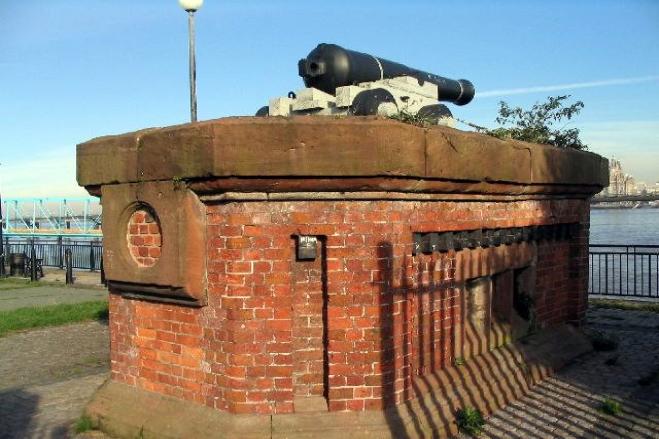
A cannon at Morpeth Dock, Birkenhead was fired remotely from Bidston Observatory at one o'clock
each working day, triggered electrically by a specially adapted Robert Molyneux clock. On the dockside,
the cannon, a relic of the Crimean wars, was loaded, and at 12.30pm each working day a member of
staff tested the connection between the clock at the Observatory and the cannon. At one second to
one o'clock the switch would be thrown at the Observatory, the firing being triggered by the next
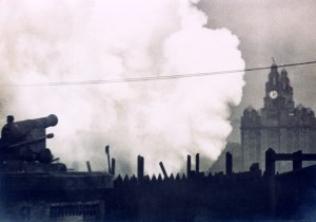
swing of the clock's pendulum. On clear days the flash could be spotted from across the Mersey.
This service was performed from 1867 until July 18th 1969, apart from a break during the Second World
War. An extra firing heralded the start of the 20th century. An attempt was made to scrap the time
signal in 1932, partly because it was no longer necessary, due to the advent of radio, but also because
of the cost of maintenance of the gun, said to be approximately one hundred pounds a year. There
was a public outcry at the prospect of the ending of this tradition, so the War Office provided a new
cannon, a 32 pounder from Woolwich Arsenal, which arrived on April 26th 1933. The old cannon was on
display in the grounds of Bidston Observatory for many years.
In 1946, after a wartime silence of six and a half years, this cannon was then replaced by a third gun,
a six pounder naval anti-aircraft Hotchkiss gun, and on June 17th the old familiar sound once more
reverberated across the River Mersey. In 1969 Bidston Observatory became a component body of the
Natural Environment Research Council, concentrating on oceanographic research, and it was decided to
discontinue the tradition of firing the One O'clock Gun on the grounds of efficiency.
One of the earlier cannons is now at the Maritime Museum, Liverpool and the transit telescope is now
in the Liverpool Museum. The clock used for the firing of the One O'Clock Gun remains on display at the
Observatory (now known as the Proudman Oceanographic Laboratory).
Dialogue & pictures taken from The Proudman Oceanographic Laboratory (POL) website.
A cannon at Morpeth Dock, Birkenhead was fired remotely from Bidston Observatory at one o'clock
each working day, triggered electrically by a specially adapted Robert Molyneux clock. On the dockside,
the cannon, a relic of the Crimean wars, was loaded, and at 12.30pm each working day a member of
staff tested the connection between the clock at the Observatory and the cannon. At one second to
one o'clock the switch would be thrown at the Observatory, the firing being triggered by the next
swing of the clock's pendulum. On clear days the flash could be spotted from across the Mersey.
This service was performed from 1867 until July 18th 1969, apart from a break during the Second World
War. An extra firing heralded the start of the 20th century. An attempt was made to scrap the time
signal in 1932, partly because it was no longer necessary, due to the advent of radio, but also because
of the cost of maintenance of the gun, said to be approximately one hundred pounds a year. There
was a public outcry at the prospect of the ending of this tradition, so the War Office provided a new
cannon, a 32 pounder from Woolwich Arsenal, which arrived on April 26th 1933. The old cannon was on
display in the grounds of Bidston Observatory for many years.
In 1946, after a wartime silence of six and a half years, this cannon was then replaced by a third gun,
a six pounder naval anti-aircraft Hotchkiss gun, and on June 17th the old familiar sound once more
reverberated across the River Mersey. In 1969 Bidston Observatory became a component body of the
Natural Environment Research Council, concentrating on oceanographic research, and it was decided to
discontinue the tradition of firing the One O'clock Gun on the grounds of efficiency.
One of the earlier cannons is now at the Maritime Museum, Liverpool and the transit telescope is now
in the Liverpool Museum. The clock used for the firing of the One O'Clock Gun remains on display at the
Observatory (now known as the Proudman Oceanographic Laboratory).
Dialogue & pictures taken from The Proudman Oceanographic Laboratory (POL) website.
| The Gun at Morpeth Docks Today |
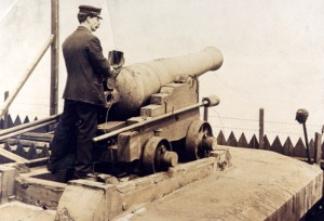
| The Gun at Morpeth Docks c1900 |
| Gun Firing over Mersey |